Art and Science International Exhibition
Initiated by Nobel Laureate in Physics, Prof. Tsung-Dao Lee, and master artist, Prof. Wu Guanzhong, the "Art and Science International Exhibition and Symposium" is a premier academic event dedicated to exploring the intersection of art and science, driving innovations in human civilization.
Since its inception in 2001, it has been successfully held six times (2006, 2012, 2016, 2019, and 2023). By showcasing cutting-edge global achievements and fostering in-depth discussions, it continues to encourage the harmony and innovative synergy between these two disciplines.
In 2026, building upon the legacy of previous editions and coinciding with the 70th anniversary of the Academy of Arts & Design, Tsinghua University, we are thrilled to open a brand-new chapter to continue exploring the modern convergence of art and science!
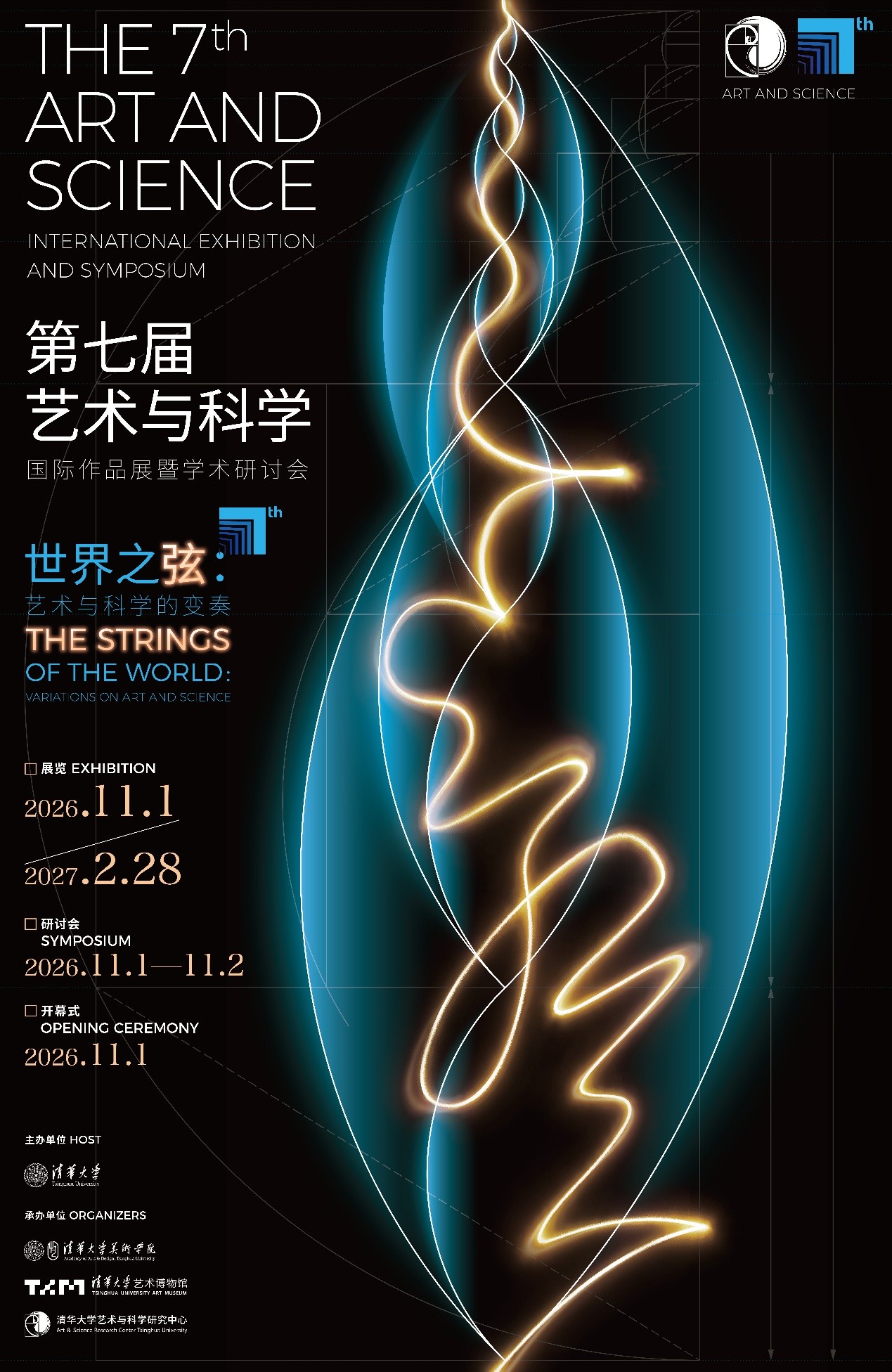
The 7th Art and Science International Exhibition and Symposium will take place in Beijing from November 1, 2026, to February 28, 2027. Hosted by Tsinghua University, the event is co-organized by the Academy of Arts & Design, the Art and Science Research Center, and the Tsinghua University Art Museum. The theme for this edition is "The Strings of the World: Variations on Art and Science."
Strings are both the poetry of art and the language of science. Their vibrations give rise to melodies and stir emotions, while also weaving space and time and offering insight into the nature of the universe. In their resonance, art and science meet, colliding, converging, and transforming into a compelling symphony of the world we inhabit.
In the 8th century BCE, Homer chanted epic poetry to the lyre. Two hundred years later, when Pythagoras plucked his strings, he found out the numerical ratios of pitch to string length, thus unraveling the mystery of harmony. That was when mankind, for the first time ever, described beauty in mathematical terms. The vibrating strings represent both physical laws and the origin of aesthetic harmony. Into the 20th century, physicists proposed the String Theory: The fundamental building blocks of the universe are not point-like particles, but tiny vibrating strings. The one-dimensional strings constitute the vast universe and a single brush stroke, similarly, creates infinite realms. As Shi Tao, a Chinese painter in early Qing Dynasty, put it in his Theory of One Stroke, where one stroke falls, myriad phenomena arise. Art and science have walked hand in hand, never truly apart.
Today, human civilization is undergoing profound technological changes, and it is now all the more important to emphasize the holistic nature of human perception. Neither is art serving to interpret science, nor is science offering substance to art. Rather, it is through variations on a shared theme that we articulate the underlying harmonies between them, interpreting and recreating anew. A new vision is unfolding: scenography, extended reality, sensory roaming, human-computer interaction, ecological intervention, collaboration with living organisms, Internet-based production, algorithmic weaving, data translation, intelligent living, and more. With every variation on the Strings of the World, we lean in and listen for the future.